
Rebranding at scale: a deep dive into Cambium’s email design strategy
The tool this VP of Marketing has bought three times.
The Wood Economy Isn’t Full of Email Experts
Wood is one of the oldest industries on earth. It is also one of the most offline.
Cambium is trying to change that. It was founded six years ago to tackle a staggering problem: tens of millions of trees fall in the U.S. every year due to disease, decay, and natural disaster, and roughly 90% of them end up in landfill or get burned. Cambium Carbon built supply chain infrastructure to salvage that waste and turn it into premium material.
Melanie Heyside, VP of Marketing, sees the opportunity clearly. Cambium just completed a full rebrand, and email is central to how they want customers to perceive the company.
"Dyspatch makes sure we have a really consistent, cohesive brand and show up in the ways that we want to. We have very high expectations for how we show up, but you need the tools to make that happen."
— Melanie Heyside, VP of Marketing at Cambium
It's a complicated business. The customer base stretches from high-end design to architecture firms specifying materials for commercial interiors. That range creates a branding challenge most tech companies never face: the brand has to flex for radically different audiences while staying cohesive enough to own a category.
A core part of making that happen is how they communicate with customers. And for Cambium, that means email, a channel that, across the entire wood industry, almost nobody is doing well.
Three Companies, One Tool: Why Dyspatch Works
Every time Melanie starts a new role, Dyspatch is the first platform she adds to the stack. She's done it three times now. That says more than any metric could.

Her path to Cambium runs through some of the most sophisticated email programs in tech. She started in marketing at Braze, where she saw firsthand what companies like Canva were doing with lifecycle and engagement. She moved to Coda (now part of the Grammarly/Superhuman family) to lead Growth Marketing, then to Arcade, and now to Cambium, where she's building a marketing team from the ground up.
At every stop, she ran into the same wall.
At Coda, the team was using Intercom to manage lifecycle email. The experience was, in her words, shocking.
"It was so inflexible. It was quite shocking how difficult it was to just make standard plain emails. I was trying to bring our brand to life in these touchpoints and I just kept getting stuck."
— Melanie Heyside, VP of Marketing at Cambium
The challenges were frustrating. It took hours to build a single email, stakeholder feedback was hard to collate, and the tools’ capabilities just weren't there. Email is a specialized skill at the intersection of design and code, and without the right tools, even an experienced marketer hits a ceiling fast.
Dyspatch unlocked their team. The ability to take Figma designs and have the Dyspatch team translate them into production-ready email templates was transformative for their small team without in-house email developers.
"The fact that we could have designs translated into built-out emails was a massive, massive unlock for us as a team."
— Melanie Heyside, VP of Marketing at Cambium
When Melanie moved to Arcade, Dyspatch was the first tool she purchased. When she moved to Cambium, the same. No evaluation. No comparison. She already knew it would do what she needed.
A Brand That Has to Flex
Cambium sits between the design studio and the mill floor. The brand has to feel native in both: same company, different register. The challenge is not softening into something generic in the middle.
"The way we show up for a design firm is very different from how we show up for a mill partner. Those are different people, but it has to feel like the same Cambium."
— Melanie Heyside, VP of Marketing at Cambium
With a marketing team of three, the challenge is both creative and operational. Every context switch between audiences, every new campaign for a different business unit, is time a small team doesn't have.
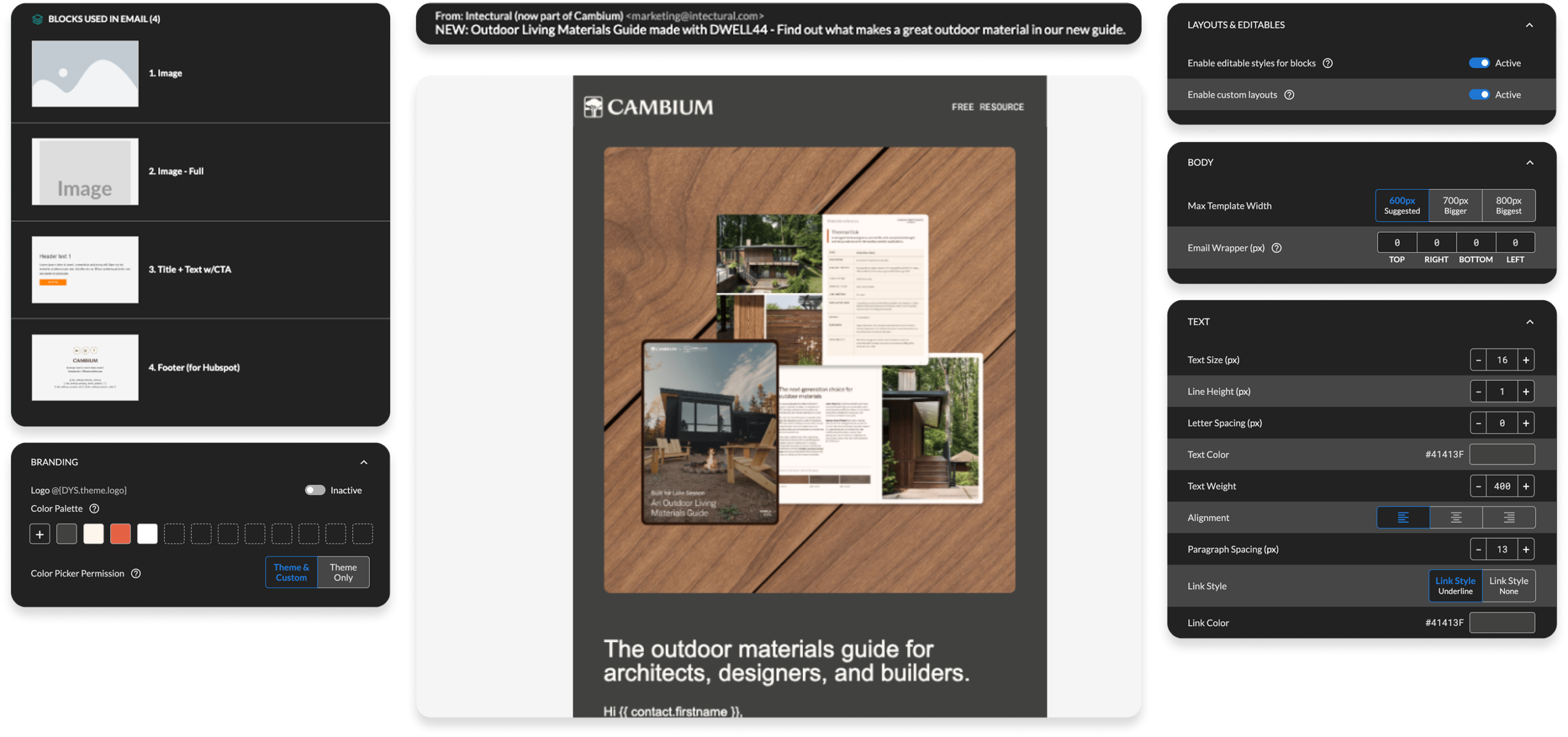
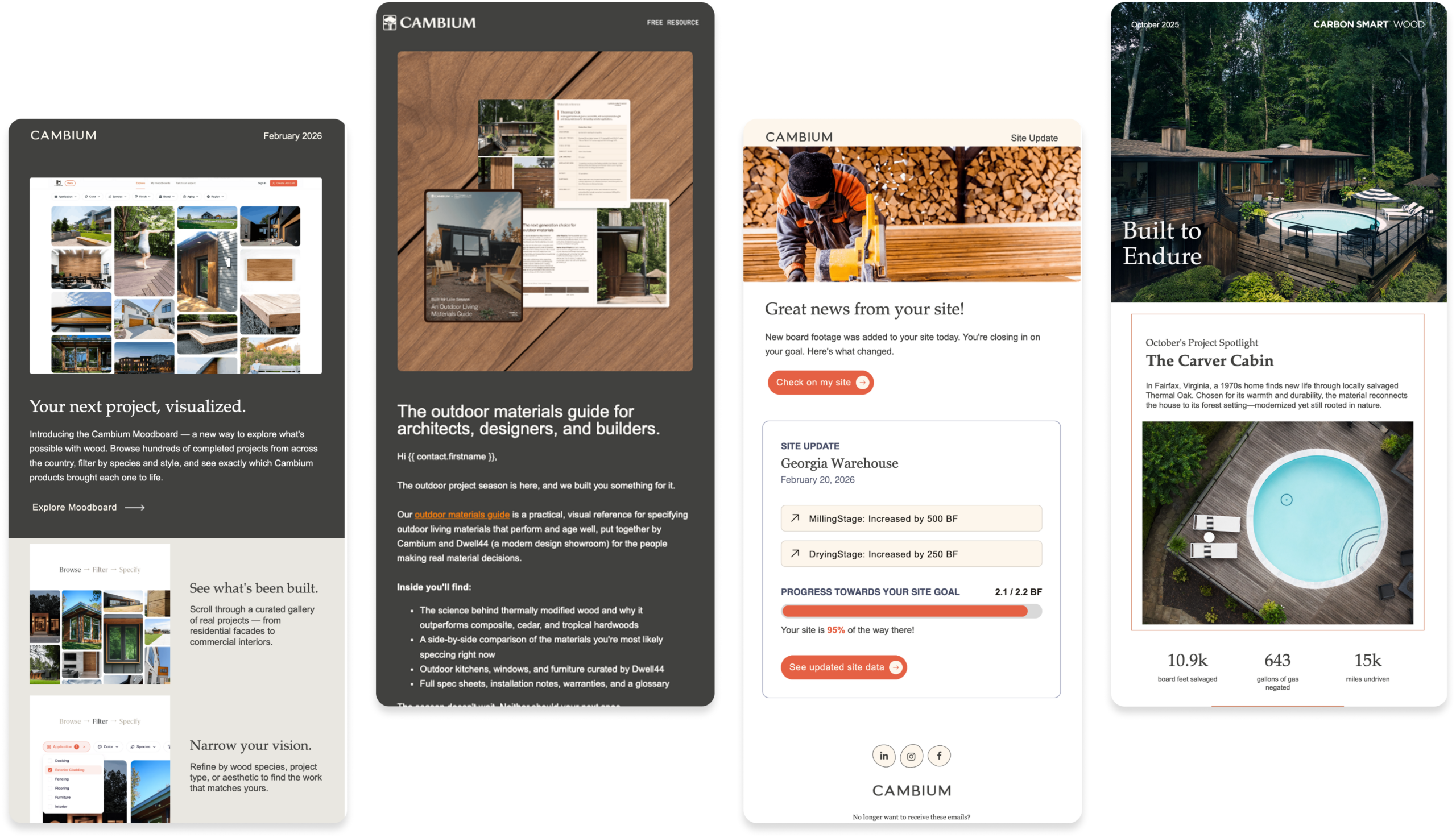
This is where Dyspatch's infrastructure pays off. With Dyspatch, Cambium maintains separate blueprints and templates for each business segment: their mill market business units (arborists, sawmills), Carbon Smart Wood, and Cambium's corporate brand. With the rebrand underway, these will evolve, but the system means Melanie's team isn't rebuilding from scratch or hunting through brand files every time they need to speak to a different audience.
"We have very high expectations for our brand and how we show up. But it's really hard to do that if you don't have systems and tools that help you design and build — especially with email being such a specialized skill set."
— Melanie Heyside, VP of Marketing at Cambium
The result is consistency without rigidity. The emails carry a clean, editorial aesthetic, the kind of design-forward work you wouldn't expect from a company that deals in lumber, and that quality holds across every audience.
From Figma to Inbox: The Workflow That Makes It Possible
Cambium doesn't have email developers. They have a talented designer who built out their initial email templates in Figma, and the Dyspatch team translated those into modular, reusable components.
Day to day, Melanie's team works within those templates and blueprints autonomously. New campaigns don't require a design brief or a development sprint. They require choosing the right blueprint, writing the content, and sending.
When Carson, the newest member of Melanie's marketing team, got a walkthrough of Dyspatch in her first weeks, the feature that stopped her was approval workflows.
"She said, 'Oh my gosh, if only I'd had this in past jobs.' The fact that all feedback can happen in one place — not scattered across Slack and Google Docs — that alone justifies using it."
— Melanie Heyside, VP of Marketing at Cambium
At Coda, where Melanie had a more robust brand team to work with, approval workflows were actually the biggest internal sell for adopting Dyspatch. Feedback doesn't get missed. Reviews don't live in three different tools. For a small team where a dropped comment can mean a broken send, that's not a nice-to-have. It's the difference between a professional operation and chaos.
From Marketing to Transactional
The best sign a tool is working is when a team you didn't onboard asks to use it.
Cambium's product team came to Melanie wanting to build transactional emails in Dyspatch — the messages tied to the supply chain platform that share live data on shipped materials, processing updates, and fulfillment status. Customers interact with these daily, and they'd been running separately from anything marketing touched.
Melanie knew the alternative. At a previous company, she found transactional emails that hadn't been updated in six years. They were off-brand, outdated, and effectively invisible to marketing.
A tool spreads when the next team can pick it up without being sold on it.
The Team Behind It
When asked what she'd want to emphasize about working with Dyspatch, Melanie didn't talk about features. She talked about people.
"I feel like whenever we work with Aileen and Sean, they always seem just excited about the new challenge and what we want to do. I don't feel that much affinity to other tools and software companies I've worked with before."
— Melanie Heyside, VP of Marketing at Cambium
Across three companies, the Dyspatch Customer Success team has been a consistent reason Melanie keeps coming back. Even on a smaller support package, the team has helped Cambium build, unblock, and iterate. For a three-person marketing team operating without dedicated email developers, that level of partnership isn't a perk. It's infrastructure.
What's Next
Cambium's full rebrand recently launched. Their website is being rebuilt from scratch. Email templates will evolve alongside the new brand identity, and the team plans to ramp up demand gen and lifecycle significantly now that a dedicated hire is in their seat.
The transactional email buildout with the product team is underway. Newsletters and regular communications continue to drive engagement. And the standard things, as Melanie puts it, are still super impactful.
For a company trying to own a category in one of the world's oldest industries, email has become a core brand-building channel. Not because it's flashy. Because it works — and because the tools finally match the ambition.
Start growing with Dyspatch
Streamline your email workflow and get better results today.
Let's ChatStart growing with Dyspatch
Streamline your email workflow and get better results today.
Get a demoRelated Case Studies
Scaling Cross-Channel Communications: The Multiverse Success Story
Scaling Cross-Channel Communications: The Multiverse Success Story Executive intro | The challenge | Implementation | Key results | What’s … Read now about Scaling Cross-Channel Communications: The Multiverse Success Story
How Premium Onboarding Catapulted Bryzos into Efficient Email Campaigns with Dyspatch
Accelerating Success: How Premium Onboarding Catapulted Bryzos into Efficient Email Campaigns with Dyspatch Executive Intro|The Technical … Read now about How Premium Onboarding Catapulted Bryzos into Efficient Email Campaigns with Dyspatch
How Culture Amp uses Dyspatch to build employee experiences in 45 languages
How Culture Amp uses Dyspatch to build employee experiences in 45 languages Executive intro | The challenge | Our proposal | The process | The … Read now about How Culture Amp uses Dyspatch to build employee experiences in 45 languages